
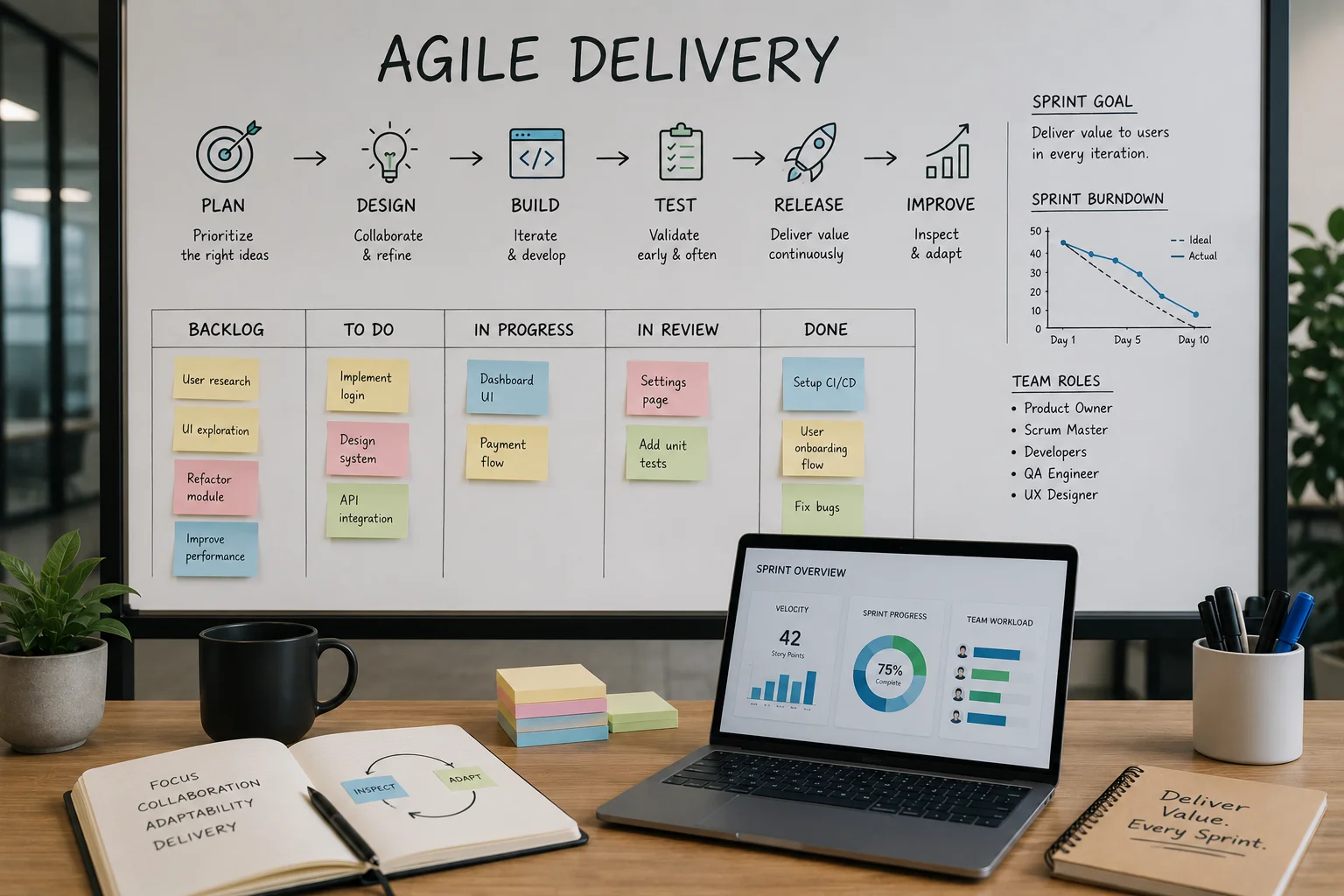
Agile Delivery
Modern software development requires organizations to respond quickly to changing customer expectations, evolving technologies, and shifting business priorities. Agile Delivery provides a flexible framework that enables teams to deliver value incrementally while continuously incorporating feedback throughout the development process.
Rather than planning every feature months in advance, Agile teams organize work into short, iterative cycles that produce working software on a regular basis. Frequent releases allow stakeholders to review progress, validate assumptions, and adjust priorities before significant time and resources are invested in the wrong direction.
Successful Agile Delivery depends on close collaboration between product, engineering, and business teams. Product owners define priorities, engineers contribute technical expertise, and stakeholders provide ongoing feedback throughout development. Transparent communication ensures that everyone remains aligned around shared goals while reducing misunderstandings and unnecessary delays.
Continuous improvement is another core principle of Agile. Retrospectives, performance metrics, and customer feedback help teams refine both their delivery process and the product itself. Small improvements made consistently over time often produce greater long-term results than large process changes implemented infrequently.
Agile does not eliminate planning or documentation—it encourages teams to create only the level of planning necessary to support informed decision-making. Engineering discipline, automated testing, and reliable deployment pipelines remain essential for delivering software quickly without compromising quality or stability.
Organizations that adopt Agile successfully focus on outcomes rather than ceremonies. When combined with strong engineering practices and a culture of collaboration, Agile Delivery enables teams to respond confidently to change while continuously delivering value to customers.