Building Reliable RAG Systems
Retrieval-Augmented Generation (RAG) has become one of the most effective ways to build enterprise AI applications. Instead of relying solely on a language model's training data, RAG combines an LLM with a knowledge retrieval system, allowing responses to be grounded in up-to-date and organization-specific information. This approach helps reduce hallucinations while improving the accuracy and relevance of AI-generated answers.
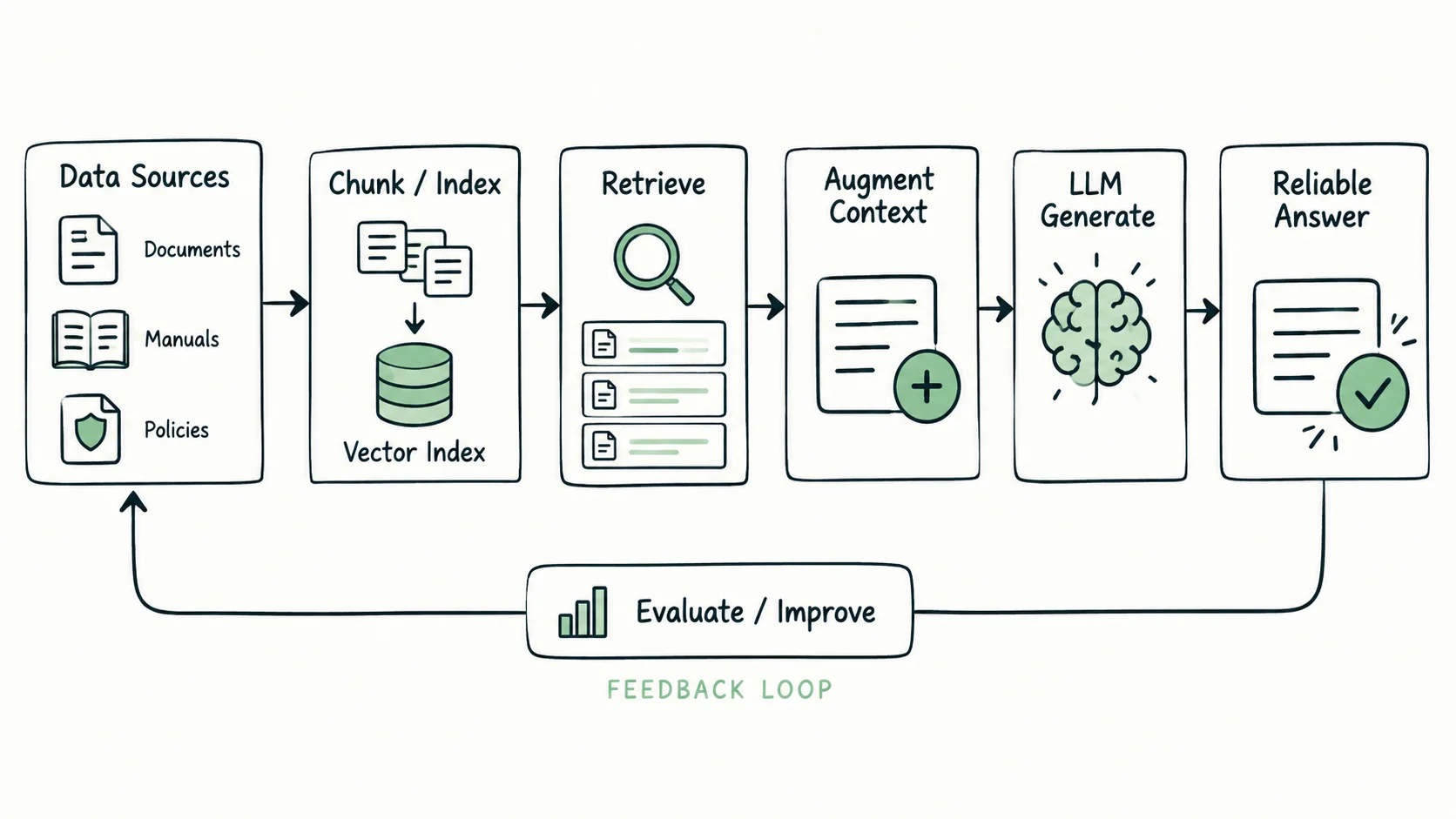
A typical RAG system consists of three main components: a knowledge source, a retrieval engine, and a language model. When a user submits a question, the retrieval engine searches for the most relevant documents, passes that context to the LLM, and generates a response based on the retrieved information. This process enables AI applications to answer questions using company documentation, product manuals, internal policies, or technical knowledge without retraining the model.
The quality of a RAG system depends heavily on the quality of its knowledge base. Outdated documentation, duplicate content, or poorly structured information can lead to inaccurate responses even when the language model performs well. Organizations should establish processes to keep documents current, remove redundant information, and organize content in ways that improve retrieval accuracy.
Retrieval itself is equally important. Choosing an appropriate chunk size, embedding strategy, and search method can significantly influence response quality. Many enterprise solutions combine semantic search with keyword matching and metadata filtering to improve precision. Returning fewer but more relevant documents often produces better results than providing the model with excessive context.
Reliability also requires governance beyond retrieval. Enterprise applications should validate responses, cite information sources where appropriate, and define confidence thresholds for sensitive use cases. Human review may still be necessary for legal, financial, or healthcare scenarios where incorrect information could have significant consequences. Monitoring user feedback and continuously evaluating answer quality are essential parts of maintaining a production-ready RAG system.
As enterprise AI adoption grows, RAG is becoming a foundation for intelligent knowledge assistants, customer support platforms, and internal productivity tools. Organizations that invest in high-quality content, effective retrieval strategies, and responsible AI governance will be better positioned to deliver trustworthy AI experiences that scale with their business needs.