
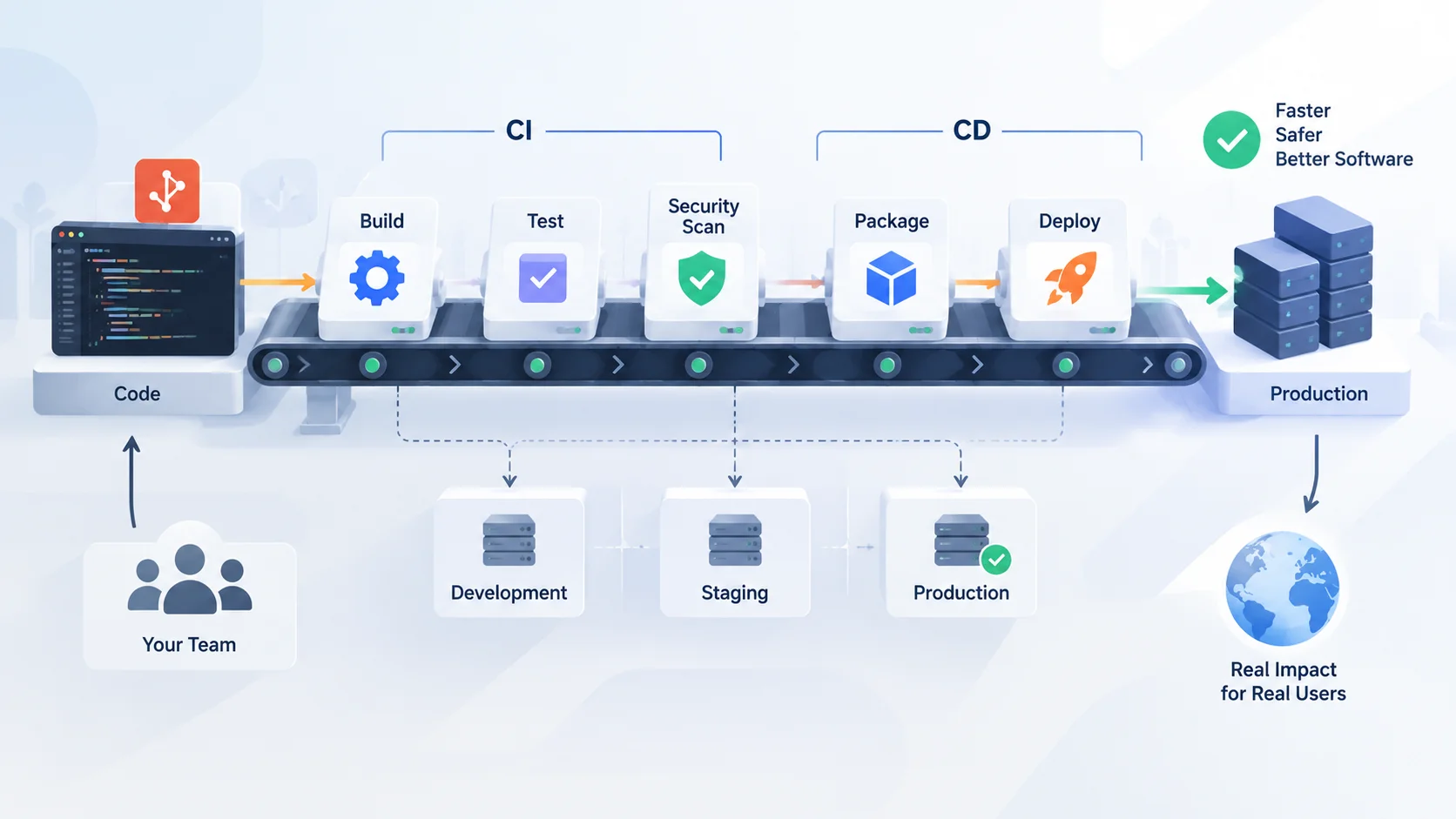
CI/CD for Enterprise Teams
Modern software development depends on delivering reliable updates quickly and consistently. Continuous Integration and Continuous Delivery (CI/CD) provide the automation needed to build, test, and deploy software efficiently while reducing manual effort and deployment risk. For enterprise teams, CI/CD is not simply a development practice—it is a foundation for predictable software delivery.
Continuous Integration encourages developers to merge code changes frequently into a shared repository. Each change automatically triggers builds, automated tests, and code quality checks, allowing issues to be identified early in the development process. Detecting problems sooner reduces integration conflicts and helps maintain a stable codebase as teams grow.
Continuous Delivery extends this automation by preparing validated software for deployment. Release pipelines automate packaging, security scanning, infrastructure provisioning, and deployment to staging environments. Approval workflows and automated rollback mechanisms further improve reliability, allowing organizations to release updates with greater confidence and lower operational risk.
Successful CI/CD pipelines also incorporate security and compliance. Automated vulnerability scanning, dependency analysis, policy validation, and infrastructure testing help identify potential issues before software reaches production. Embedding these controls directly into delivery pipelines supports a DevSecOps approach where security becomes part of the development workflow rather than a separate review process.
Enterprise environments often involve multiple teams, applications, and deployment targets. Standardized pipeline templates, reusable automation, and centralized monitoring promote consistency across projects while reducing maintenance overhead. Clear deployment strategies such as blue-green or canary releases further minimize disruption during production updates.
CI/CD is ultimately about enabling teams to deliver value continuously without compromising quality. Organizations that invest in automation, testing, and reliable deployment practices can respond more quickly to changing business needs while maintaining the stability and trust expected from enterprise software systems.