
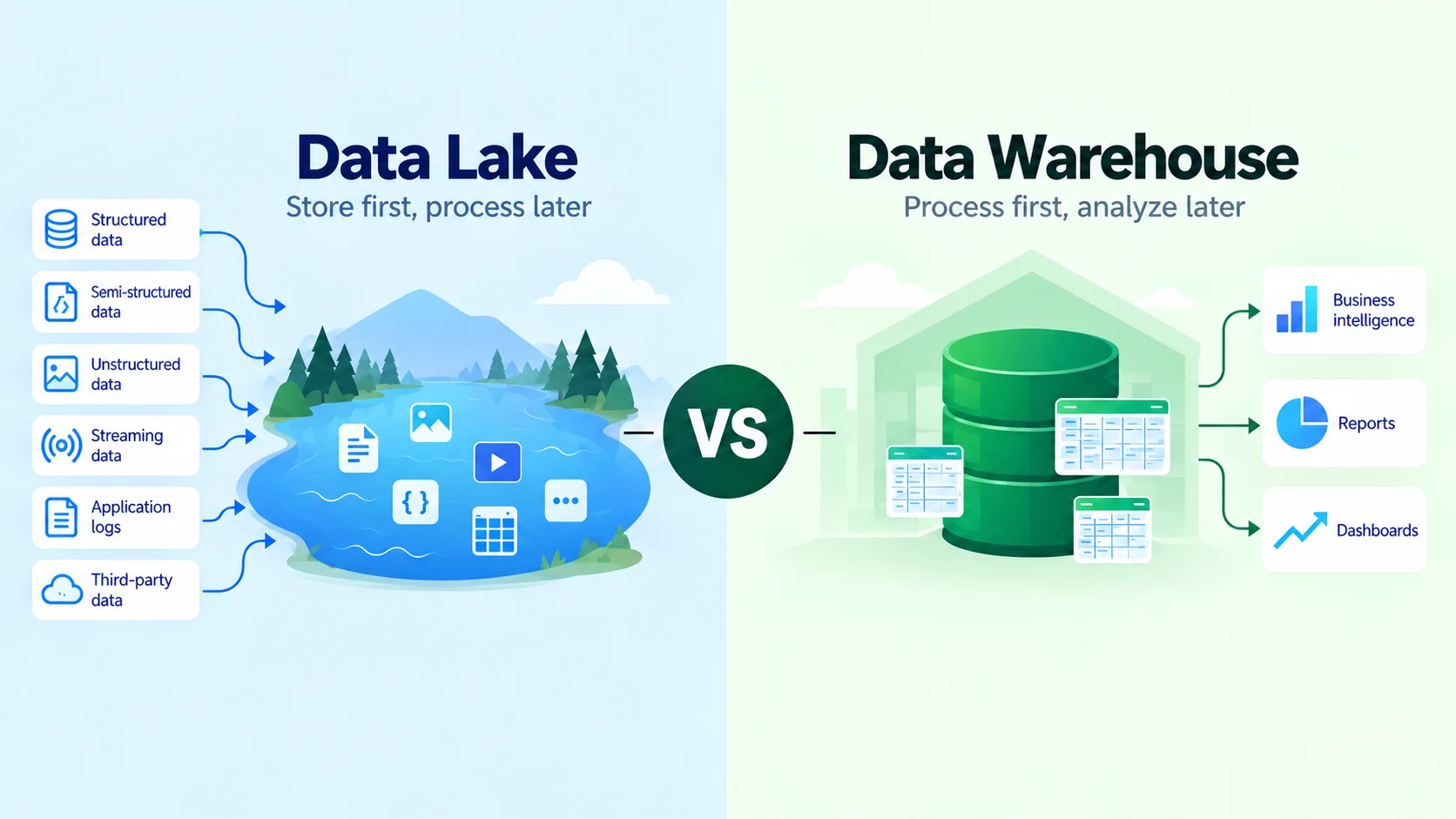
Data Lake vs Data Warehouse
As organizations collect increasing volumes of data, choosing the right storage architecture becomes an important strategic decision. Two of the most common approaches are data lakes and data warehouses. While both support analytics and business intelligence, they serve different purposes and are designed to handle different types of data and workloads.
A data warehouse is optimized for structured, curated data that supports reporting, dashboards, and business analysis. Information is cleaned, transformed, and organized before being stored, ensuring consistent data quality and reliable performance. This makes data warehouses well suited for financial reporting, operational metrics, and executive decision-making where accuracy and consistency are essential.
A data lake takes a more flexible approach by storing raw data in its original format. Structured, semi-structured, and unstructured data can all be collected without predefined schemas, making data lakes ideal for machine learning, advanced analytics, and large-scale data exploration. Data scientists and engineering teams often use data lakes to experiment with new datasets before transforming them for production use.
Rather than choosing one architecture over the other, many organizations combine both. Raw operational data is first collected in a data lake, where it remains available for exploration and AI initiatives. Processed and validated datasets are then published to a data warehouse, providing trusted information for business users and reporting platforms. This layered approach balances flexibility with governance.
Selecting the right solution depends on business objectives rather than technology trends. Organizations focused on operational reporting may benefit primarily from a data warehouse, while businesses investing in AI, predictive analytics, or IoT often require the scalability and flexibility of a data lake. Understanding how data will be consumed is more important than selecting a particular platform.
As enterprise data strategies continue to evolve, modern architectures increasingly integrate both technologies into a unified ecosystem. Combining scalable storage, strong governance, and efficient data pipelines enables organizations to transform growing volumes of information into reliable business insights and competitive advantage.