
Monolith vs Microservices
Choosing between a monolithic architecture and microservices is one of the most important technical decisions in modern software development. While microservices have become increasingly popular, they are not automatically the right solution for every application. The best architecture depends on business requirements, team maturity, and long-term operational goals.
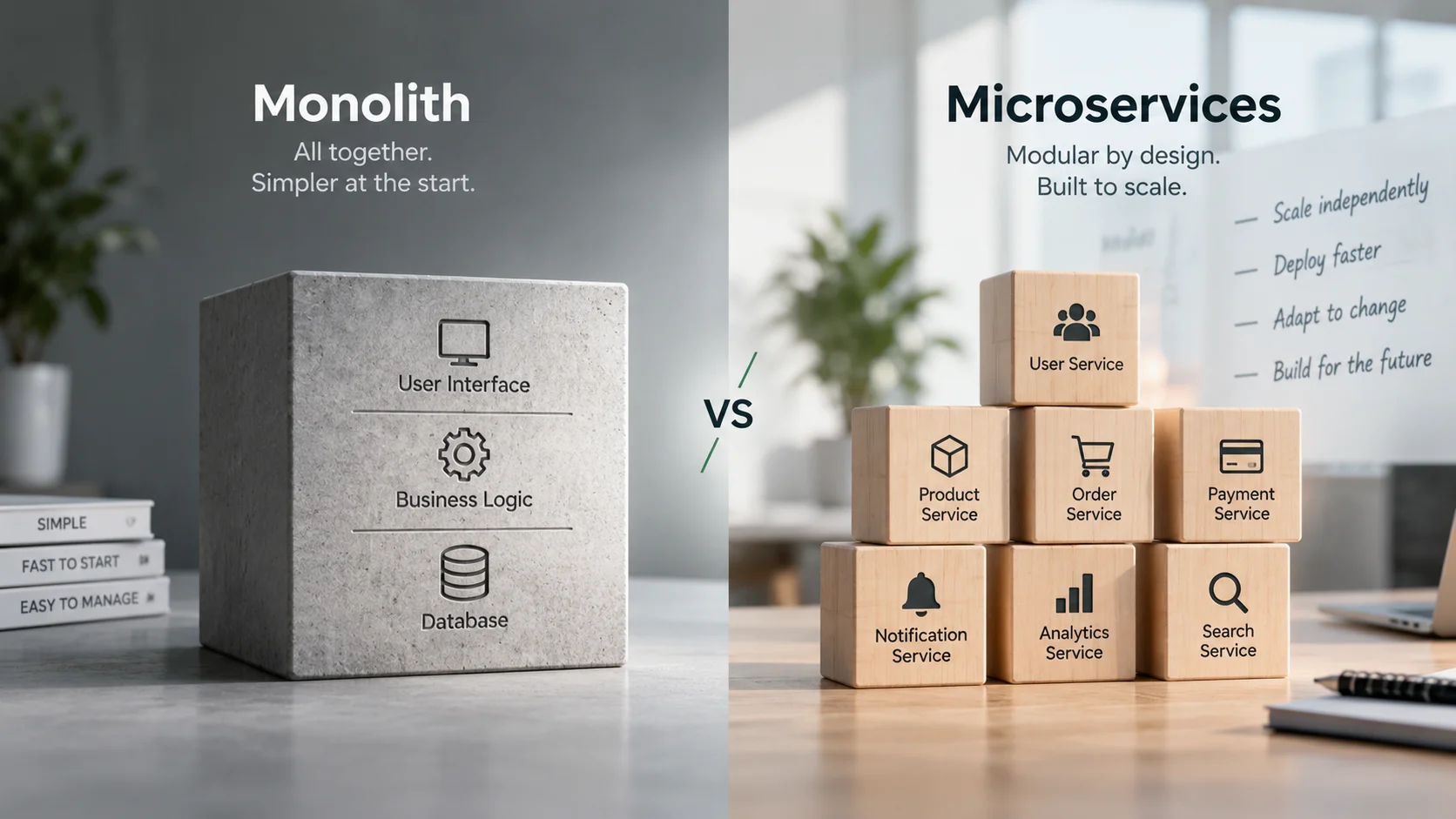
A monolithic application keeps all business functionality within a single deployable system. This approach is often easier to develop, test, and deploy during the early stages of a product. Teams benefit from simpler infrastructure, straightforward debugging, and fewer operational dependencies, making monoliths a practical choice for many startups and smaller applications.
Microservices divide an application into independently deployable services, each responsible for a specific business capability. This architecture allows different teams to develop, deploy, and scale services independently. It also enables organizations to adopt different technologies where appropriate and improve resilience by isolating failures within individual services.
However, microservices introduce additional complexity. Service communication, distributed transactions, monitoring, logging, security, and deployment automation all require careful planning. Without mature DevSecOps practices and experienced engineering teams, the operational overhead may outweigh the architectural benefits.
Rather than viewing the decision as a binary choice, many organizations adopt an evolutionary approach. Products often begin as well-structured monoliths and gradually extract services as business complexity increases. This strategy allows teams to avoid unnecessary complexity while maintaining flexibility for future growth.
There is no universally superior architecture. A successful engineering organization chooses the approach that best supports its product, customers, and development teams. The goal is not to follow industry trends, but to build software that remains reliable, maintainable, and adaptable as the business evolves.