
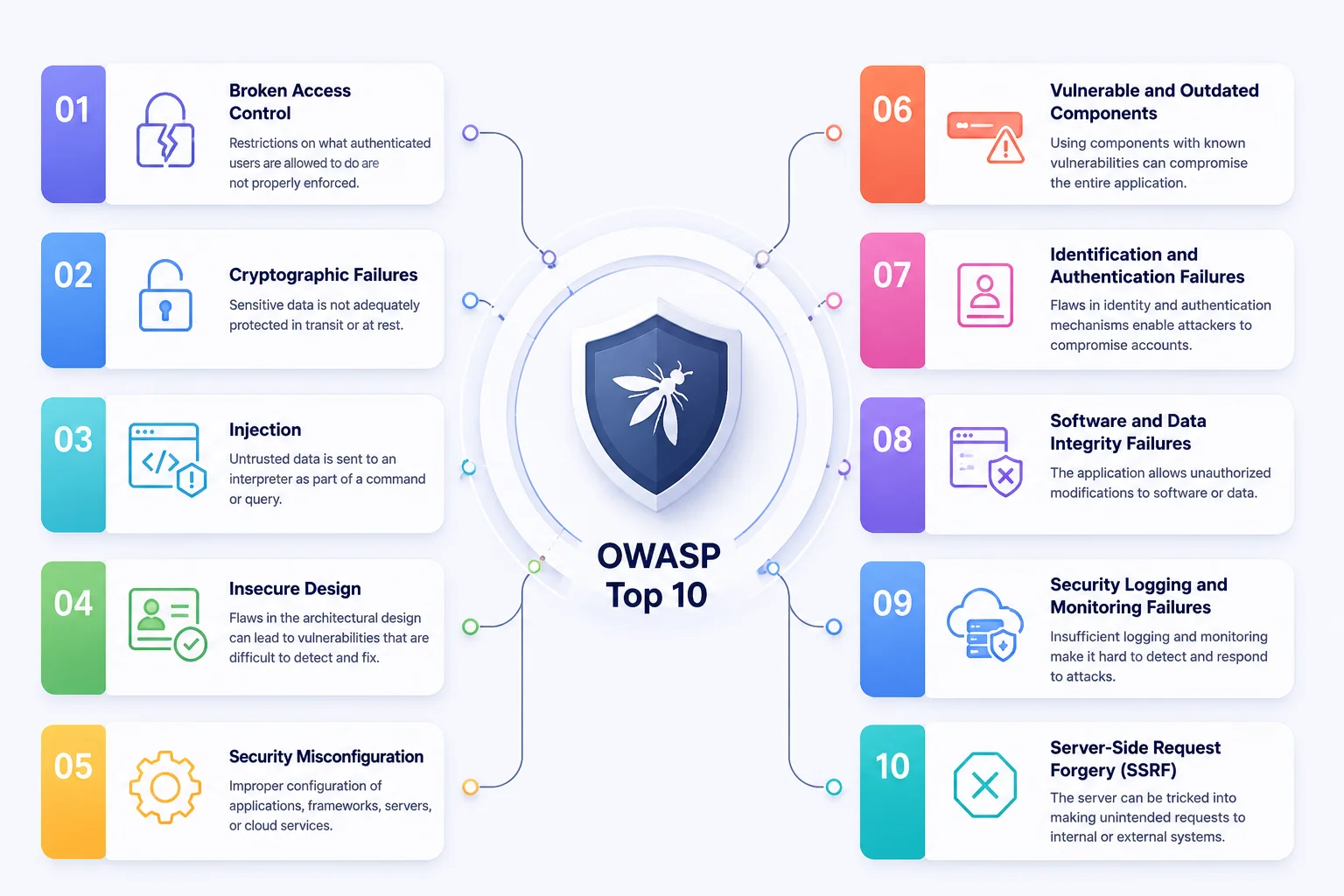
OWASP Top 10
Web applications remain one of the most common targets for cyber attacks, making secure software development a critical business priority. The OWASP Top 10 provides a widely recognized list of the most significant security risks affecting modern web applications. Rather than serving as a checklist, it helps engineering teams understand where vulnerabilities commonly occur and how they can be prevented.
The list highlights risks such as broken access control, cryptographic failures, injection attacks, insecure design, security misconfiguration, vulnerable components, authentication weaknesses, software integrity failures, insufficient logging, and server-side request forgery. These issues often result from insecure coding practices, inadequate testing, or weaknesses in application architecture.
Understanding these risks allows development teams to make better security decisions throughout the software lifecycle. Secure authentication mechanisms, input validation, encryption, access controls, and proper error handling should become standard engineering practices rather than optional enhancements. Security awareness training also helps developers recognize common attack patterns before vulnerabilities are introduced.
Automated security tools can further strengthen application security. Static analysis, dependency scanning, dynamic testing, and vulnerability management platforms help identify known weaknesses early in development. Combined with peer reviews and penetration testing, these practices significantly reduce the likelihood of exploitable vulnerabilities reaching production.
Addressing the OWASP Top 10 is not about achieving perfect security—it is about reducing the most common and impactful risks through disciplined engineering practices. Organizations should continuously review their applications, update security controls, and respond to newly discovered threats as technologies evolve.
For modern software teams, the OWASP Top 10 provides a practical foundation for building more secure applications. By incorporating its principles into everyday development workflows, organizations can strengthen customer trust, improve regulatory compliance, and reduce the likelihood of costly security incidents.